
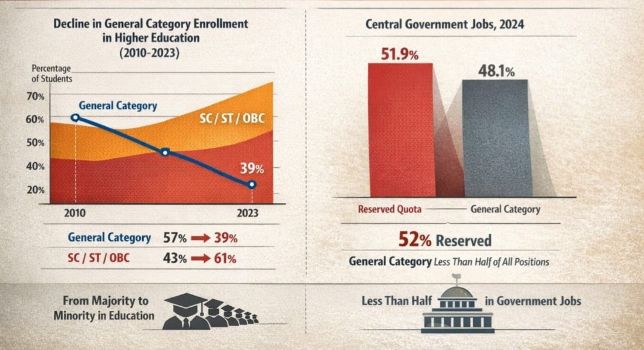
India’s reservation system was created with a clear purpose: to help communities that had been historically pushed to the margins. It was meant to be a temporary bridge to equality, not a permanent political weapon. Yet today, that bridge has become a bottleneck-one that quietly shrinks opportunities for students and job-seekers in the General category, while deepening social division rather than healing it.
Over the years, the “lower” caste categories have kept expanding, and thus, the reservation too has expanded far beyond its original intent. In colleges and universities, students from reserved categories now make up the majority! This did not happen overnight, nor by accident. Each expansion is defended in the name of social justice, yet almost none are seriously reviewed to ask a fundamental question: Is the policy still serving its original purpose? The answer is no, not because the General category mirrors Western racial hierarchies, but because importing grievance frameworks from the West has created a false analogy that distorts India’s social reality.
For General category students, the result is a fast-disappearing playing field due to blatant discrimination. Why? Indian babus and mantris have copied and pasted venomous Marxist policies from the West and imposed them on the Indian system without any sense of nuance. Data shows that the competition has become brutally uneven, and caste trumps merit. Reserved-category candidates can compete for both quota seats and open seats, while General category students are limited to a narrowing slice of opportunities. This is not equality of opportunity; it is asymmetric competition dressed up as fairness, Marxism parading as appeasement politics.
The same pattern appears in government jobs. Today, more than half of many public-sector positions are reserved by policy design. This means the General category automatically competes for fewer than half of all government jobs—even before exams are written or interviews begin. Over time, this situation has created frustration, resentment, and a sense that effort no longer guarantees reward.
Defenders of the system argue that representation is justice. But representation without periodic review becomes entitlement, and entitlement without limits becomes political appeasement. Reservation has increasingly become a vote-bank tool—expanded not because data demands it, but because elections reward it. Politicians perceive gains in new constituencies, while bureaucracies avoid actual reform. The cost is passed quietly to those who lack numbers and are seen as the oppressors for no good reason.
Worse, the system now encourages distortion. In some states, religious conversion opens the door to reservation benefits, turning affirmative action into a government-sponsored incentive to change religious identity. In extreme cases, General category students have even harmed themselves to qualify under disability quotas. When policy creates desperation, something is profoundly broken. However, those in power in whichever party do not seem to care about the worsening state of education by generating upper-caste hatred.
None of this means that historical injustice should be ignored. It means the opposite: justice must be honest to remain just. A policy meant to uplift cannot become a permanent structure that punishes merit, freezes identity, and divides society into competing grievance groups. Merit should be taken into account in enrollment and job placement, as should economic conditions when doling out needed freebies.
If reservation was meant to unite India, its current form is doing the opposite. True justice demands courage: the courage to reform what no longer works, even when it is perceived to be politically inconvenient. i.e., Crafting and implementing sound policies, not pushing agendas by mischievous mantris and bewafa babus. India cannot become a global economic leader while steadily devaluing excellence and effort. A fair system would regularly review reservations, focus on real economic disadvantage, and gradually reduce quotas where progress has already been made. Equality should mean lifting the weakest—not pushing everyone else down.

- Appeasement Politics in India is Erasing the General Category - February 7, 2026
- Revisiting 1947 Partition & Its Unfinished Business: A Treaty-Based Framework for Minority Protection in the Indian Subcontinent. - January 8, 2026
- Navarro’s Anti-Brahmin Rant: Buffoonery or a Calculated Attack on India? - September 4, 2025