
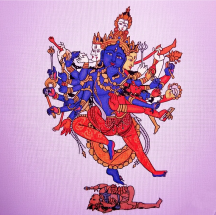
Bhārat, across its diverse & variegated cultural landscape ranging from Hindukush to Kanyakumari, has been a place which always celebrated the feminine energy of nature.
Shaktism is one such tradition centred on the worship of the divine feminine as the supreme deity, embodied as Shakti or Devi, representing the dynamic cosmic energy responsible for creation, preservation, and destruction of the universe. This tradition views the Goddess as the ultimate reality and the source of all power, often depicted in both nurturing and fierce forms to symbolise the multifaceted nature of existence. Shaktism emphasises the feminine principle as integral to spiritual liberation.
The earliest Goddess statue excavated in India is from modern-day Prayagraj. It corresponds to the upper Palaeolithic age (20,000 – 23,000 BC). The artefacts of that period are some colourful stones with natural triangles. These have connections to the yantras used by Tantrics, and the triangles are associated with fertility. Discovered near Mirzapur in Uttar Pradesh, these stones are still worshipped as Devi by the tribal people of the area. Thousands of small female statues, dated as early as c. 5500 BCE, have been recovered at Mehrgarh (in Balochistan, Pakistan), one of the important Neolithic sites in world archaeology, and a precursor to the great Indus Valley Civilisation. The Goddess worship was even prevalent in the Indus Valley Civilisation, where female statues were found in almost every household. Most statues are naked and have elaborate hairstyles. Some statues have ornaments or horns on the head, and a few are in poses that expose the genitals (yoni), which were also found. The objects and images found suggest that the goddess cults of the Indus Valley Civilisation were associated with fertility. A seal was discovered with a male figure standing over a female figure with a sickle. This indicates an association between the female and crops, and perhaps implies a sacrifice ritual.
The feminine is worshipped in different forms by various sects in Bhārat, which can be classified based on three rough themes. These are :
BASED ON ORIGIN
1. THE TRIBAL/FOLK SHAKTISM
Tribal /Folk Shaktism is perhaps the oldest form of Shaktism in India. It involves the worship of both tribal and local Goddesses. The tribal Goddesses are generally worshipped as old women. The local Goddesses are generally rocks or other natural objects that have revealed themselves to villagers. The folk Shaktism is practised to heal the diseases, to bestow fertility to all living beings and to get rid of the spirits of ancestors. In West Bengal, the Goddesses are generally worshipped in several forms. The Goddess may be the tribals’ dark and powerful Kali, the hunters’ Chandi; the snake goddess Manasa; the smallpox goddess Shitala, etc. She is also worshipped as Gramdevatas and Yoginis.
The folk tradition is primarily an oral tradition, handed down from village elders or priests to the followers. Likewise, the traditions of goddess worship are passed down to the next generation.
2. TANTRIC/YOGIC SHAKTISM
Tantric/Yogic Shaktism is the second form. In 6th-century CE writings, elements of tantric thought are found, and by the 9th century CE, texts called tantras are found in writings. The Goddesses are generally depicted in certain forms of meditation and ritual worship. It involves the practice of different tantric mantras and body postures. Kundalini yoga is often an element in this. The meaning of Kundalini is a spiritual energy or life force located at the base of the spine and is perceived as a coiled-up snake. The practice of Kundalini yoga is believed to stimulate the sleeping Kundalini Shakti through the six chakras and penetrate the seventh and the last chakra, or the crown. Kundalini Yoga has a tri-fold tactic, i.e. Bhakti yoga (devotional power), Shakti yoga (physical strength), and Raja yoga (mental control). In West Bengal, there are two major subtypes of the Tantric strand, i.e., folk tantra and classical tantra. In folk tantra, the importance is on ritual practice, direct experience, and practical results. It is largely an oral tradition. In classical tantra, the Goddess is the symbol of liberation (moksha) and consciousness (Brahman). It is believed that the Goddess grants omniscience to the classical tantrika.
3. DEVOTIONAL/BHAKTI SHAKTISM
Devotional or Bhakti Shaktism is the third form. In this method, the Goddess is worshipped as a loving mother. It is the combination of Shakta bhakti and Vedanta
philosophy, and its committed followers come from all castes and social statuses. Thus, it may be called “non-sectarian Shaktism.”
BASED ON PRACTICE
1. SRIKULA
Srikula, or the “family of Sri,” reveres Lalita Tripura Sundari as the central goddess, portraying her as benign, beautiful, and saumya (gentle). This tradition emerged prominently in South India by the 7th century, thriving in regions like Kerala, Tamil Nadu, and parts of Sri Lanka. Key practices involve the Shri Yantra, a complex geometric diagram for meditation, visualization, and rituals, alongside magnificent texts like the Lalita Sahasranama – dedicated to the divine splendour of Sri Lalita Devi found in the Brahmanda Purana which elucidates the cosmic order and divine creation of the universe and Saundarya Lahri – written by Sri Adishankaracharya in praise of the glory of the Divine Mother Tripura Sundari.
The Srividya paramparas can be subdivided into two streams, the Kaula (a practice of vamamarga) and Samaya (a practice of dakshinamarga). The Kaula or Kaulachara first appeared as a coherent ritual system in the eighth century in central India, and its most revered theorist is the eighteenth-century Bhaskararaya philosopher, widely regarded as “the best exponent of the Shakta philosophy “.
Samaya or Samayacharya has its roots in the work of commentator Lakshmidhara of the sixteenth century, and is “fiercely puritanical Tantric practical reform attempts”.
2. KALIKULA
Kālīkrama or Kālīkula means the path where Goddess Kālī, with her consort Mahākāla (a form of Sadāśiva), her Āvaraṇa Devatās & Parivāra Devatās is worshipped. Kalikula emphasises fierce forms like Kali, Durga, and Chamunda, focusing on their ugra (terrifying) and protective aspects.
The Kalikula form of Shaktism is most dominant in north & eastern India, and is most widely prevalent in West Bengal, Assam, Mithila, Odisha and Nepal, and also previously in Kashmir (the Kaula tradition). The goddesses Kubjika, Kulesvari, Chamunda, Chandi, Shamshan Kali, Dakshina Kali, and Siddheshwari are worshipped in the region of Bengal to protect against disease and smallpox as well as ill omens. Kalikula lineages focus upon the Devi as the source of wisdom (vidya) and liberation (moksha). Core Texts include Devi Mahatmayam (Chandi Path) from Markandeya Purān & Devi Bhagwat Purān.
Following are the different kramas (schools) of Kālīkula: –
1) Kādi Krama (कादि क्रम)
2) Krodha Krama (क्रोध क्रम)
3) Hādi Krama (हादि क्रम)
4) Vāgādi Krama (वागादि क्रम)
5) Nādi Krama (नादि क्रम)
6) Dādi Krama (दादि क्रम)
7) Praṇavādi Krama (प्रणवादि क्रम).
Each branch has its own Mistress or residing Goddess or (कुलाधिष्ठात्री), Texts, Guru lineages, Mantras, Yantras, Practices, Āvaraṇa Devatās and Parivāra Devatās.
Regional branches of Kālīkula are as follows: –
1) Kāśmīra Krama
2) Nepāla Krama
3) Mithilā Krama
4) Gauḍa or Vaṅga Krama
5) Kerala Krama
Dating these traditions is very difficult, but the Kali-kula is usually considered to be an older tradition than the Shri-kula, despite the latter’s tendency to push its origin back to the Vedas. As Teun Goudriaan and Sanjuka Gupta assert, “The beginnings of Kalikula literature can be traced back further than those of the Srikula”.
BASED ON GEOGRAPHICAL DOMAINS
The three krantas-Ashvakranta, Vishnu Kranta, and Ratha Kranta-are geographical and doctrinal divisions of Bharata in Shakta Tantric texts like the Mahasiddhasara Tantra and Shaktimangala Tantra, centred around the Vindhya mountains.
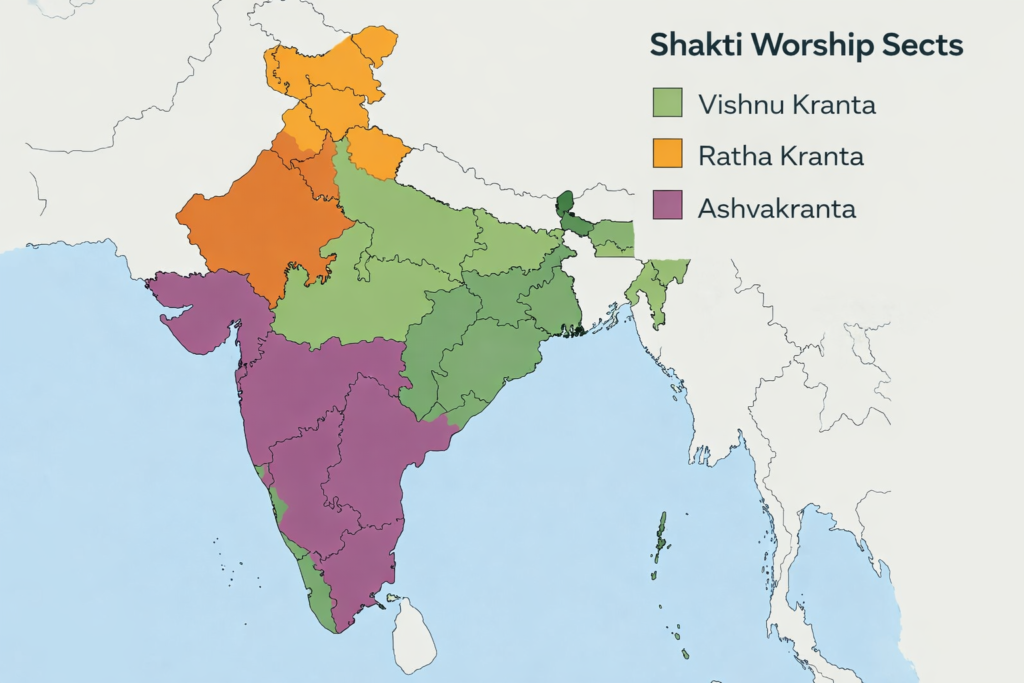
Geographical Distinctions
These divisions map Shaktism’s spread, with each tied to specific regions and transport metaphors (horse for Ashva, chariot for Ratha, vessel for Vishnu).
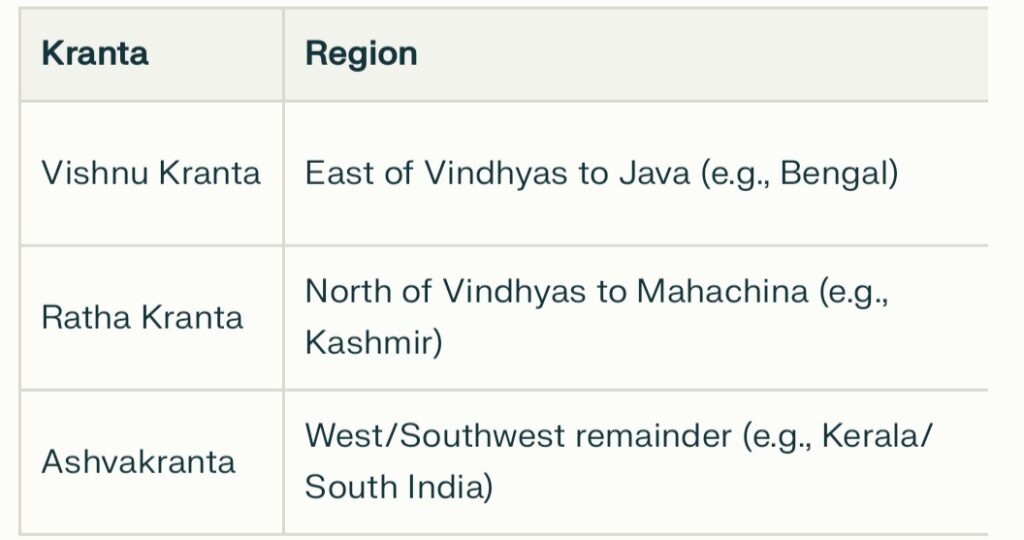
While sharing core tantric elements like panchatattva and kundalini, distinctions lie in Devi forms, rituals, and regional adaptations-Kali rites in the east (Vishnu), Tara in the north (Ratha), and symbolic Sri Yantra puja in the southwest (Ashva).
All integrate with Shaktism’s Shakti-Brahman unity but vary by local culture and availability.
SOURCES:-
1. Musings on Hinduism by Nithin Sridhar
2. Durga Bhakti Tarangini Blogpost
3. Auspicious Wisdom: The Texts and Traditions of Śrividyā Śākta Tantrism in South India -Douglas Renfrew Brooks
4. 51 Shaktipithas: The Kernel of Shaktism in South Asia –
Suresh K. Singh

- KRANTAS & KULĀS: MAPPING THE SHAKTA SECTS OF BHĀRAT - March 28, 2026
- KSHARAN-BODH (क्षरण-बोध): How do Civilizations Fall & Decay? - January 17, 2026
- BHĀRAT: EVOLUTION OF A DYNAMIC & DIVINE RĀSHTRA - September 12, 2023